
Scammers impersonate a trusted garage door company by copying the parts of it you can actually see. They build lookalike websites with local phone numbers, buy search ads on the real company’s name, answer the phone without ever stating a business name, and show up in unmarked trucks with no uniform and no ID. The goal is to get a technician standing in your garage before you realize you never reached the company you searched for. Almost every version of this scam fails the same three checks: confirm the phone number against the company’s own website, confirm the physical address on a map, and confirm the technician’s identity at the door before any work starts.
Key takeaways
- The impersonation almost always happens before anyone touches your door. By the time a technician is in your driveway, the deception is already complete.
- The single most reliable defense is a callback. Hang up, find the number on the company’s real website, and dial it yourself.
- Scammers concentrate on emergencies, because a stuck door removes your ability to shop around.
- An unmarked vehicle, a technician with no ID, and a refusal to put the price in writing are the three strongest at-the-door warning signs.
- A license or insurance number printed on paperwork proves nothing on its own. Numbers get copied. Verify them independently.
- If you have already paid an impersonator, report it. Reporting is what makes these operations traceable.
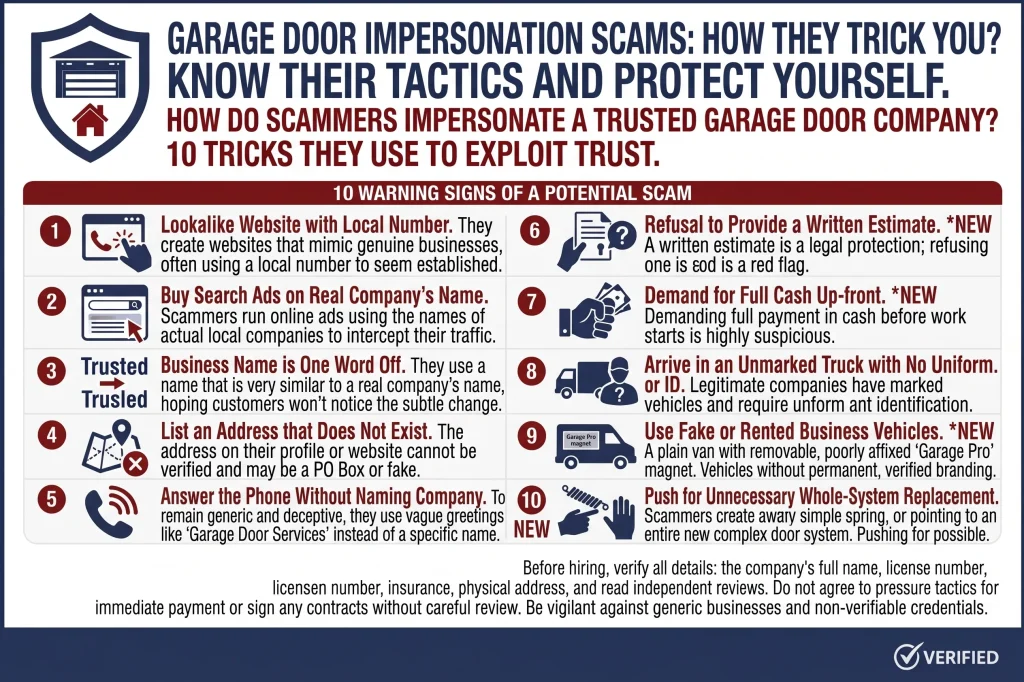
1. They build a lookalike website with a local phone number
What it looks like: A clean, professional site with a local area code, local city names, and stock photos of technicians. It appears legitimate because it is designed to. The phone number routes to a call center that may be nowhere near you.
Why it works: You are not comparing the site to anything. You searched, you found a plausible local company, you called. This pattern is documented well beyond any one market. Local news investigations have reported fake garage door websites using genuine local phone numbers to target homeowners in specific cities.
How to check: Look for a real street address, a business name that matches across every page, and a phone number that appears identically on the site, on Google, and on the company’s social profiles. Any mismatch is worth a pause. The full verification process is covered in Is This Garage Door Company’s Website Real? 7 Ways to Check.
Call a pro if: You are searching under pressure because the door will not move. If you are dealing with a garage door that is stuck and will not open, the urgency is exactly what the scam is built to exploit. The better long-term protection is to find a real company before you need one, ideally when you book routine garage door maintenance, and save their number.
How to tell if a garage door company’s website is the real one
Open the company’s Google Business Profile and the website separately. The phone number, business name, and address should match exactly across both. Then call the number listed on Google rather than the one in the ad you clicked.
2. They buy search ads on the real company’s name
What it looks like: You search for a garage door company by name. The first result is a paid ad that is not that company. It may use similar wording, similar colors, and a similar name.
Why it works: Most people do not distinguish between an ad and an organic result, and the top position reads as an endorsement. Nothing about paid placement verifies who the advertiser is.
How to check: Scroll past the ads. Look for the result with the company’s actual domain. If you already know the company, type the domain directly into your browser rather than searching for it. This tactic is widespread enough that the industry issues periodic warnings about it, including an industry alert from the International Door Association.
Call a pro if: You are not certain which result is the real business. Call a number you have used before, or one printed on an invoice from previous work.
Why the top result for a garage door company may not be that company
Paid ads sit above organic results and are labeled only with a small “Sponsored” tag. An impersonator can bid on a competitor’s brand name and appear above them.
3. They use a business name that is one word off
What it looks like: “Garage Door Service Pros” instead of the local company you meant to call. Generic, forgettable, and close enough that you do not notice the difference.
Why it works: Garage door company names are naturally similar, so a copycat name does not stand out. Scam operations also rotate names, which makes them hard to track and hard to review.
How to check: A legitimate company uses one name consistently on its website, its invoices, its truck, and its advertising. Clopay’s own guidance notes that scam operations often work under multiple names, generic names, or unclear names, and that a real dealer’s name should appear consistently everywhere. Their guide to avoiding garage door scams is worth reading before you book anything.
Call a pro if: The name on the paperwork does not match the name you called. Stop the work at that point and do not sign.
How to spot a copycat garage door company name
Search the exact business name in quotation marks. A real local company will have a consistent trail: reviews, a mapped address, and matching listings. A copycat name usually returns almost nothing, or returns several unrelated businesses.
4. They list an address that does not exist
What it looks like: A street address in the footer that turns out to be a vacant lot, a mailbox store, a residential house, or nothing at all.
Why it works: An address on a website reads as proof of a real business. Almost nobody checks it.
How to check: Copy the address into Google Maps and look at Street View. A real garage door company has a shop, a yard, a warehouse, or an office. If the pin lands on an empty lot or a strip mall mailbox counter, you have your answer in under a minute.
Call a pro if: The address checks out but you still feel uncertain. Ask on the phone for the address and compare it to the website. A legitimate dispatcher answers that instantly.
Why you should check a garage door company’s address on the map
An address takes seconds to verify and is one of the hardest things for a fake operation to fake convincingly. It is the highest-value check per second spent.
5. They answer the phone without naming the company
What it looks like: You call. Someone says “garage door service” or just “hello.” Ask which company you have reached and the answer is vague, delayed, or different from the name on the website.
Why it works: A single call center often fields calls for many fake listings at once, so the person answering cannot commit to one business name.
How to check: Ask two direct questions: what is the full name of your company, and what is your address. A real dispatcher answers both without hesitation and both will match the website. Any stumbling is meaningful. When you reach a real company for garage door repair, you should be able to confirm who you are speaking to in the first ten seconds.
Call a pro if: The answers do not match. Hang up and call a company you can verify.
What to listen for when you call a garage door company
Listen for the company name stated clearly and confidently on pickup. Listen for a technician’s name and an arrival window. Listen for a willingness to give a written estimate before work begins.
6. They pad a profile with borrowed or fabricated reviews
What it looks like: A high star rating built from short, generic reviews posted in clusters, often with no photos and no specific details about the work performed.
Why it works: Star ratings are a shortcut for trust, and most people read the number rather than the reviews.
How to check: Read the actual text of the newest reviews. Real reviews mention specifics: a broken spring, a sensor alignment, a technician’s name, a delay. Fake reviews are vague and interchangeable. Also check whether reviews arrived in bursts on the same few days.
Call a pro if: The reviews look thin but the company otherwise checks out. Ask for references or look for the business in a manufacturer’s dealer locator, which requires a real, verified relationship.
How to check whether garage door company reviews are real
Sort reviews by newest and read ten of them. Look for named technicians, named parts, and specific complaints answered by the owner. That pattern is difficult to manufacture at volume.
7. They arrive in an unmarked truck with no uniform or ID
What it looks like: An unmarked van or personal vehicle. No logo, no uniform, no visible identification, and often no written work order.
Why it works: By this point you have already booked the appointment, so you are expecting someone. The absence of branding registers as unremarkable rather than alarming.
How to check: Ask for photo ID and the name of the company before anyone comes inside. Compare it to the booking confirmation you received. This is a documented pattern, not a theoretical one. The International Door Association’s scam awareness hub, which tracks reported cases, has collected news coverage including an incident where a repairman arrived in an unmarked truck and asked to come inside a home. The full at-the-door process is covered in How Do I Know If a Garage Door Tech Is Legit? 6 Checks Before You Let Them In.
Call a pro if: You are alone and uncomfortable. You are never obligated to let anyone in. Close the door, call the company’s published number, and confirm whether they dispatched anyone to your address.
How to verify a garage door technician at your door
Ask for a name, ask which company they represent, and ask to see the work order. Then call the number from the company’s website and confirm the dispatch. A legitimate technician expects this and will wait.
8. They put someone else’s license or insurance number on the paperwork
What it looks like: A professional-looking invoice or estimate with a license number, an insurance carrier, and a bond reference printed at the bottom.
Why it works: A printed credential number looks like verification. It is not. Numbers are public in many jurisdictions and are trivial to copy onto a document.
How to check: Look the number up yourself with your state or provincial licensing body, and confirm the name attached to that license matches the company standing in your driveway. Ask for a certificate of insurance issued directly by the carrier rather than a number typed on an invoice.
Call a pro if: The credential does not resolve to the same business name. That mismatch is enough on its own to stop the job.
How to confirm a garage door company is licensed and insured
Verify the license number against the issuing authority’s public database, not against the company’s own paperwork. The name on the license must match the name on the invoice.
9. They advertise a rock bottom service call, then escalate on site
What it looks like: An advertised service call fee far below what any real company could sustain. Once the technician is in the garage, the diagnosis expands: the springs, the cables, the rollers, the opener, the panels. The final number bears no relationship to the ad.
Why it works: The low advertised fee is the hook, and it works because most homeowners have no reference point for what garage door parts and labor should cost. Clopay’s guidance makes the same point directly: many scams advertise a low service call fee and add charges later, so you should get a quote on all recommended work before agreeing to anything.
How to check: Know roughly what is actually wrong before anyone arrives. A surprising number of failures have cheap, genuine fixes. A door that reverses before closing is very often a sensor alignment issue, and a remote that stopped working is frequently a battery or a reprogram. Our guide to why a garage door will not work and the 10 most common reasons covers the realistic causes. If someone quotes a full garage door panel replacement for a problem that presents as a sensor fault, get a second opinion before authorizing it. The mechanics of this escalation are broken down in Is a Cheap Garage Door Repair Ad a Scam? 8 Ways the Price Goes Up.
Call a pro if: The work genuinely involves torsion springs or cables. Do not attempt spring work yourself under any circumstances. Springs hold extreme stored tension and cause serious injuries every year. The correct response to a broken spring is a qualified technician, not a DIY attempt and not a stranger you cannot verify.
Why a cheap garage door repair price goes up once work starts
The advertised fee covers the visit, not the repair. Everything after the diagnosis is priced separately, and an impersonator has no reputation to protect when setting those numbers.
10. They push for immediate payment or a same day replacement contract
What it looks like: Cash or card demanded on the spot, no itemized invoice, no company letterhead, and no paperwork you can trace afterward. In the more aggressive version, the technician declares the entire door unsafe and produces a replacement contract to sign immediately.
Why it works: Urgency suppresses second opinions. If the door is unsafe today, there is no time to compare quotes, which is precisely the point.
How to check: Ask for an itemized written invoice with the business name, address, and license number before you pay. Then ask whether the recommendation can wait a day. A real technician will tell you honestly which repairs are urgent and which are not. Full door replacement is occasionally the right call, but it is a planned decision, not an emergency one. Before you commit, it is worth understanding the average lifespan of a garage door and reading through the homeowner’s guide to picking a new garage door. A legitimate garage door installation involves measurements, a written scope, and a scheduled date, not a signature obtained in a driveway.
Call a pro if: You feel rushed. Pressure to decide immediately is itself the warning sign, independent of anything else.
How to avoid paying a garage door scammer
Pay by a traceable method, never in cash, and only against an itemized invoice carrying the company’s legal name and address. Traceability is what gives you recourse later.
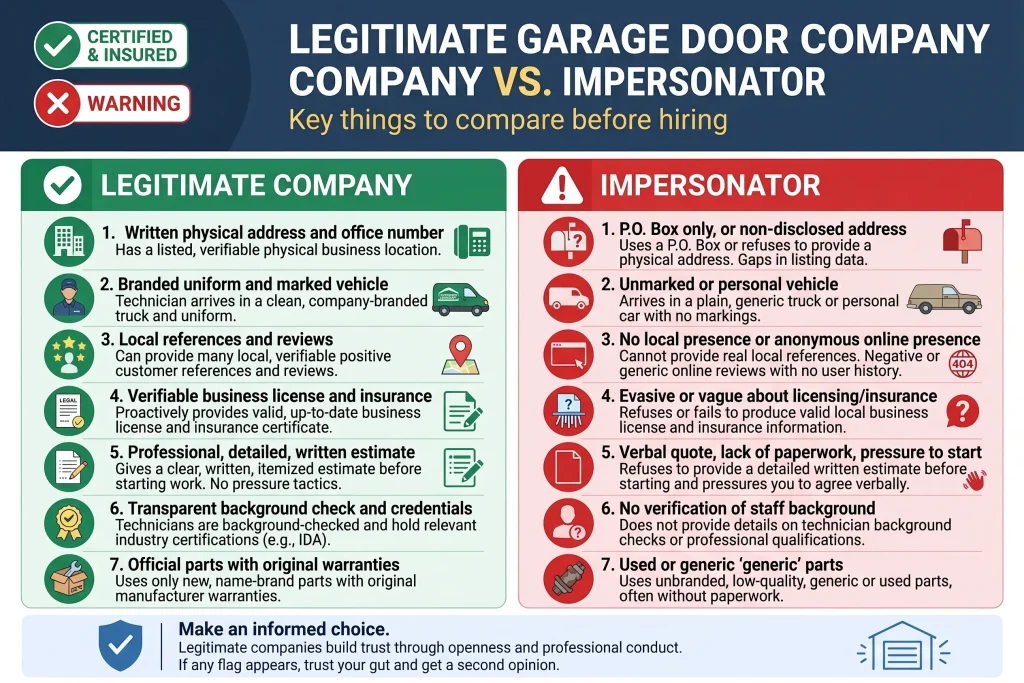
Legitimate company vs. impersonator: what to compare
|
What you can check |
A legitimate garage door company |
An impersonator |
|
Business name |
One consistent name on the site, the truck, and the invoice |
Generic or shifting; may differ from the name you called |
|
Phone answer |
States the company name clearly on pickup |
Vague greeting, no company name, or a different name |
|
Address |
A real, mappable shop, office, or yard |
Vacant lot, mailbox store, or no address at all |
|
Vehicle and uniform |
Marked truck, branded uniform, visible ID |
Unmarked vehicle, no ID, no work order |
|
Credentials |
License verifiable with the issuing authority, insurance certificate from the carrier |
Numbers printed on paperwork that do not resolve to the same name |
|
Pricing |
Written estimate before work begins |
Low advertised fee, escalating on-site total, verbal only |
|
Payment |
Traceable payment against an itemized invoice |
Cash preferred, no invoice, no traceable record |
|
Timeline |
Tells you honestly what can wait |
Everything is urgent and must be decided now |
The bottom line
Every one of these ten tricks depends on you not making a single phone call. Impersonation works because the scammer controls the first point of contact, whether that is an ad, a website, or a phone line. The moment you independently look up a company and dial its published number, the entire structure collapses.
If you are ever unsure whether the technician at your door is really from Good Guys Garage Door Service, stop and call us before you let anyone in. We would far rather answer a two minute verification call than help a homeowner clean up after an impersonator.
Need work done by a company you can actually verify? Contact us for a free quote and we will confirm the technician’s name and arrival window in writing before we come out.
