
A rock bottom garage door repair ad is not automatically a scam, but it is almost never the price you end up paying. The advertised number is a visit fee, not a repair fee, and everything after the diagnosis is priced separately. In a bait-and-switch, the technician arrives, performs a free inspection, and produces a list of failures that expands the job well beyond anything the ad implied. The defense is simple and it works: refuse to authorize any work until you have an itemized written estimate covering every recommended item, and get a second quote before agreeing to anything major.
Key takeaways
- The advertised fee buys a technician’s arrival. It rarely covers parts or labor.
- A free inspection is a sales opportunity, not a favor. Treat the resulting list as a proposal to evaluate, not a diagnosis to accept.
- Several of the most common garage door failures have inexpensive, genuine fixes. Knowing which ones is your best protection against being oversold.
- Written estimates before work begins are standard practice. A refusal to provide one is the clearest single warning sign.
- Not every upsell is dishonest. Some recommendations are correct and necessary, and this article explains which ones.
- You can stop a job at any point before work starts. Feeling committed because someone drove out to you is exactly the pressure the tactic relies on.
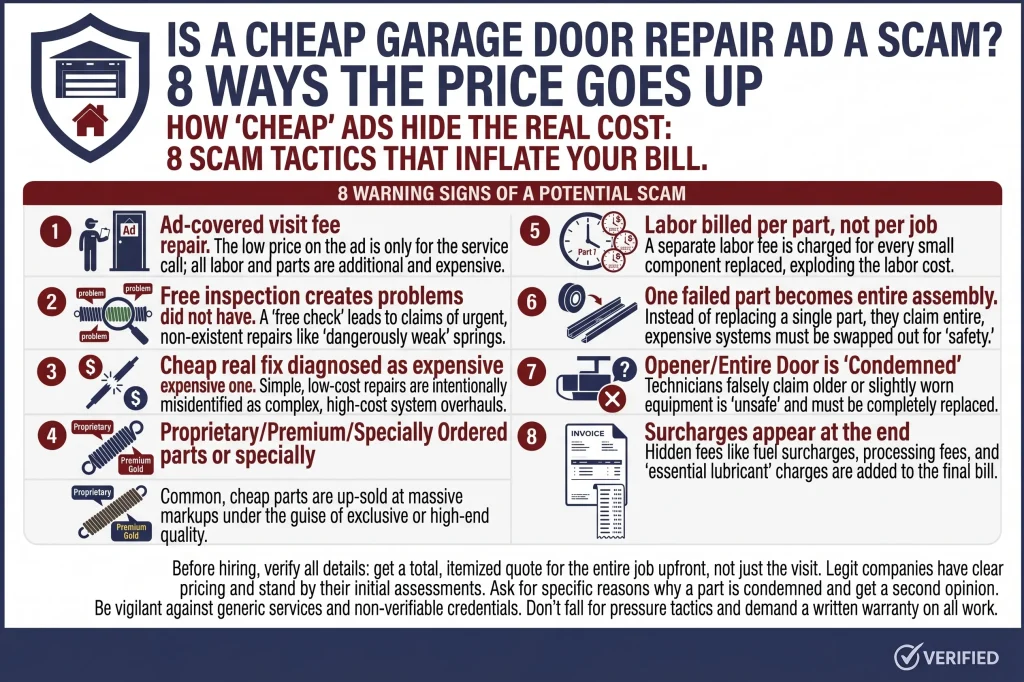
1. The advertised fee covers the visit, not the repair
What happens: You call the number in the ad expecting the advertised amount to be roughly what you pay. The technician arrives, diagnoses the problem, and presents a total that bears no relationship to the ad. Nothing was technically misrepresented, because the fine print described a service call.
Why it works: Most homeowners read an advertised repair price as a repair price. The distinction between a diagnostic visit and the actual work is obvious to anyone in the trade and invisible to almost everyone else.
What legitimate practice looks like: Real companies charge service call fees too, and there is nothing wrong with that. The difference is disclosure. A legitimate dispatcher tells you on the phone what the visit costs, what it covers, and whether it is credited toward the repair if you proceed. A bait-and-switch operation avoids that conversation entirely.
What to do: Ask two questions before booking. Does the advertised amount cover parts and labor, or only the visit? And is the visit fee applied to the repair if I go ahead? Clear answers to both are a good sign.
This pricing hook is one part of a larger pattern. For the full picture of how these operations are built, read How Do Scammers Impersonate a Trusted Garage Door Company? 10 Tricks They Use.
Why a cheap garage door repair price goes up once the technician arrives
The advertised amount is a diagnostic visit fee. Parts and labor are quoted separately after the inspection, which is where the real number appears.
2. The free inspection produces problems you did not have
What happens: You called about one specific issue. The technician performs a complimentary full-system inspection and returns with a list: the rollers are worn, the cables are fraying, the springs are near the end of their cycle life, the opener is outdated. Your original problem is now item four on a longer list.
Why it works: The findings are unfalsifiable from where you are standing. You cannot assess roller wear or spring cycle life yourself, and the person telling you is the only expert present. Volume alone creates pressure, because a list of six problems feels more urgent than one.
What legitimate practice looks like: Honest technicians do find additional issues, and reporting them is part of the job. The distinguishing feature is how they are presented. A real inspection separates urgent from eventual: this needs doing today, this should be watched, this can wait a year. A sales inspection presents everything as urgent.
What to do: Ask the technician to sort the list into what is failing now and what is merely aging. Then ask them to show you. Worn rollers and frayed cables are visible. If someone cannot or will not point at the problem, that is meaningful.
A scheduled garage door maintenance visit is the honest version of this, because you are paying for the assessment rather than receiving it free from someone who profits from what it finds. If the ad that brought you here led to an unfamiliar website, it is also worth running through Is This Garage Door Company’s Website Real? 7 Ways to Check before anyone starts work.
What a garage door free inspection really is
A free inspection is performed by someone whose income depends on what it finds. Ask for the list to be separated into urgent and non-urgent, and ask to be shown each item.
3. A cheap real fix gets diagnosed as an expensive one
What happens: The actual fault is minor and inexpensive to correct. It gets described instead as a component failure requiring replacement parts and significant labor.
Why it works: Garage door systems look complicated, and homeowners rarely know which symptoms map to which causes. A door that will not close could be a five minute adjustment or a genuine mechanical failure, and from the outside those look identical.
The most commonly inflated ones: A door that reverses before closing is very often a photo eye sensor that has been knocked out of alignment or has something in front of it, and the correction can take minutes. A remote that has stopped working is frequently a dead battery or a unit that needs reprogramming, not a failed opener. Both get quoted as major work often enough to be worth naming.
What to do: Spend five minutes understanding the likely cause before anyone arrives. Our guide to why a garage door will not work and the 10 most common reasons covers the realistic explanations for the most common symptoms. You do not need to diagnose it correctly. You only need enough context to ask an informed question, which changes the conversation completely.
Safety note: Sensor alignment and remote batteries are reasonable things to check yourself. Torsion springs and cables are not. Springs hold extreme stored tension and cause serious injuries every year. If the diagnosis involves springs, the correct response is a qualified technician, never a DIY attempt.
How to tell if a garage door problem is actually cheap to fix
Sensor misalignment, dead remote batteries, obstructed tracks, and disconnected openers are all common and inexpensive. If a quote for one of those runs into major-repair territory, get a second opinion.
4. Parts get described as proprietary, premium, or specially ordered
What happens: The quote includes parts characterized as heavy duty, commercial grade, proprietary to your opener brand, or requiring special order. The description justifies a price well above standard components.
Why it works: You have no reference point for what garage door parts cost or which ones are genuinely brand-specific. The technical framing discourages questions.
What legitimate practice looks like: Some parts genuinely are brand-specific, particularly opener logic boards and certain remote systems. Higher grade rollers and springs with longer cycle ratings are also real products worth paying for in some situations. The distinction is whether the upgrade is explained as a choice or presented as the only option.
What to do: Ask for the part number and the manufacturer. Ask whether a standard equivalent exists and what the difference is. A technician who knows their trade answers those easily. Ask for the old part back as well, which is standard practice and occasionally revealing.
Brand impersonation and misrepresentation are common enough that the trade association issues periodic public warnings, including an alert from the International Door Association.
What to do next: If the quote seems out of line, call a second company for garage door repair and describe the parts named. A second opinion on the same part list is the fastest way to find out whether the pricing is reasonable.
How to check if garage door parts are really proprietary
Ask for the part number and manufacturer, then ask whether a standard equivalent exists. Opener logic boards are often genuinely brand-specific. Rollers, hinges, and cables usually are not.
5. Labor gets billed per part instead of per job
What happens: Six components get replaced and the invoice carries six separate labor charges, even though the technician was in your garage once and several of those parts sit inches apart.
Why it works: Itemized invoices look transparent. Line-by-line detail signals honesty, which makes the structure underneath easy to miss.
What legitimate practice looks like: Different repairs genuinely do take different amounts of time, and there is nothing wrong with itemized labor. The problem is duplicated labor, where the same access work is charged repeatedly across parts replaced in a single visit.
What to do: Ask for the total labor hours for the whole visit, not per line. Then compare that to how long the technician was actually there. If the billed hours exceed the visit, ask why. This is one of the few checks you can perform with no technical knowledge at all.
You are also entitled to know who is doing the work and who they represent before any of this starts. The at-the-door verification process is covered in How Do I Know If a Garage Door Tech Is Legit? 6 Checks Before You Let Them In.
How garage door labor charges should be presented
Ask for total labor hours for the visit rather than per line item. Billed hours that exceed the time the technician spent on site deserve an explanation.
6. One failed part becomes an entire assembly
What happens: A single roller, hinge, or panel section has failed. The quote covers the full set, the complete track assembly, or several panels.
Why it works: Wholesale replacement sounds thorough and responsible, and thoroughness is what you want from a repair. The recommendation is easy to accept because it sounds like care.
Where this is genuinely correct: This is important and it cuts against the general theme of this article. Some full-set replacements are legitimately the right call. Clopay’s own guidance on avoiding garage door scams notes that when a door has two springs, both should be replaced at the same time. That is correct practice, not an upsell. Springs installed together wear at similar rates, and replacing only one means paying for a second visit shortly afterward. The same logic sometimes applies to a full set of rollers.
Where it is not: A single damaged panel from a minor impact does not usually require replacing the whole door. A garage door panel replacement on the affected section is often sufficient, depending on the age of the door and whether matching panels are still manufactured.
What to do: Ask the technician to explain why the whole assembly rather than the failed component. A correct recommendation comes with a real reason. An upsell comes with a vague appeal to thoroughness.
When replacing a whole garage door assembly is actually necessary
Paired torsion springs should be replaced together, and a full roller set often makes sense at once. A single damaged panel usually does not require a whole new door.
7. The opener or the entire door gets condemned
What happens: The conversation shifts from repair to replacement. The opener is described as obsolete and unsafe, or the door itself is declared beyond economical repair, and a replacement quote appears.
Why it works: Safety framing is difficult to argue with, particularly when you have no way to evaluate the claim and the person making it is standing in your garage.
What legitimate practice looks like: Doors and openers do reach the end of their service lives, and replacement genuinely is sometimes the better economic decision. Openers manufactured before modern safety reversal requirements are a real concern rather than a sales line. The distinguishing feature is timing. A legitimate replacement recommendation is a planned decision made with a written scope and a scheduled date. A garage door installation done properly involves measurements and preparation, not a signature obtained in a driveway on the day of a repair call.
What to do: Ask whether the door is unsafe to operate today or simply aging. If it is genuinely unsafe, ask what secures the opening tonight while you get a second quote. Before committing to replacement, it is worth knowing the average lifespan of a garage door so you can judge whether yours is actually near the end, and our homeowner’s guide to picking a new garage door covers what to weigh once replacement really is the right call.
When a garage door actually needs replacing instead of repairing
Age, structural damage, and pre-safety-standard openers are legitimate replacement reasons. A replacement contract produced during an unrelated repair call is not a decision you need to make that day.
8. Surcharges and add-ons appear at the end
What happens: The quoted figure grows at the invoice stage through emergency call fees, after-hours rates, same-day surcharges, disposal fees, trip charges, or a service plan enrollment nobody mentioned.
Why it works: By the time the invoice appears the work is finished, and disputing charges after the fact is far harder than declining them beforehand. Emergencies compound this, because you agreed under pressure.
Why emergencies matter so much here: This is the highest-risk scenario for exactly this reason. The International Door Association’s scam awareness resources note that homeowners are frequently targeted during emergencies and pressured into inflated prices, and recommend verifying credentials and avoiding upfront payment. If you are dealing with a garage door that is stuck and will not open, that urgency is the leverage.
What to do: Ask directly whether the written estimate is the final amount including all fees, taxes, and surcharges. Get the answer before work begins. If after-hours rates apply, ask what they are and whether the job can wait until standard hours.
How to avoid surprise garage door repair charges
Ask whether the written estimate is the final total including all fees and surcharges, and get that confirmation before any work starts.
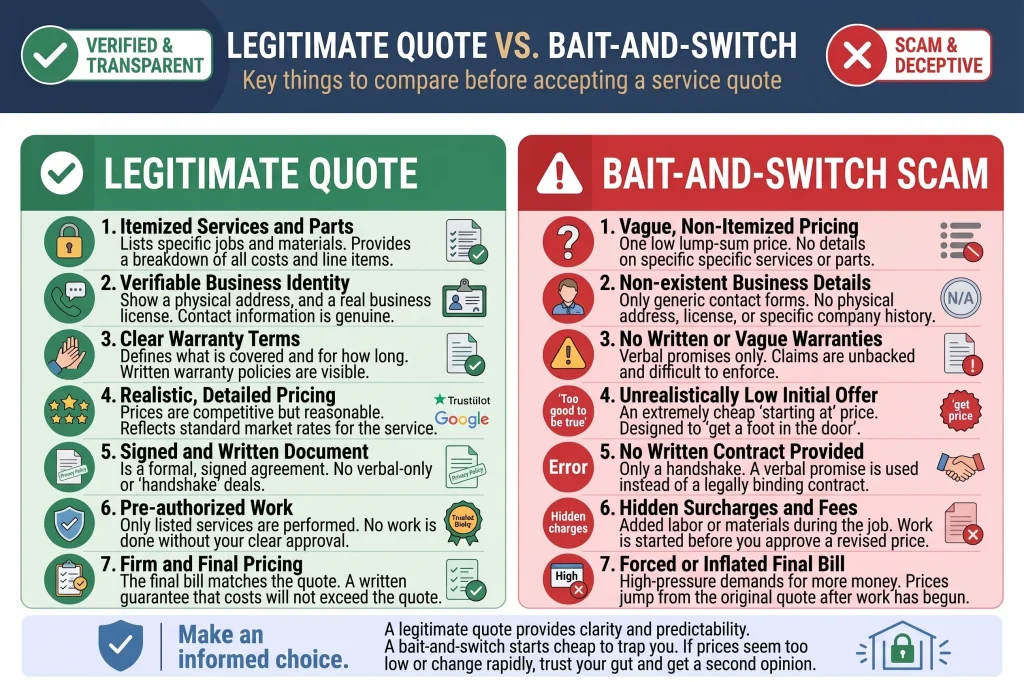
Legitimate quote vs. bait-and-switch: what to compare
|
What to look at |
A legitimate quote |
A bait-and-switch |
|
Service call fee |
Disclosed on the phone, often credited toward the repair |
Advertised low, explained only after arrival |
|
Written estimate |
Provided before work begins, itemized |
Verbal only, or produced after the work is done |
|
Inspection findings |
Sorted into urgent and non-urgent, shown to you |
Everything urgent, nothing demonstrated |
|
Parts |
Part numbers given, alternatives explained |
Vague premium or proprietary framing, no numbers |
|
Labor |
Total hours for the visit |
Duplicated across multiple line items |
|
Replacement advice |
Reason given, scheduled for later |
Pushed as a same-day decision |
|
Final total |
Confirmed as inclusive before starting |
Grows through fees added at invoicing |
|
Second opinion |
Encouraged or unbothered |
Discouraged or actively resisted |
The bottom line
Almost every version of this problem comes down to one habit: get the price in writing before anyone touches the door. A written itemized estimate collapses most of the eight tactics above, because each of them depends on the number staying flexible until the work is finished.
The second habit is a second quote. It costs you a phone call and it gives you the reference point that overselling depends on you not having. Any honest company expects it, and none of us mind. If you would like a written estimate to compare against something you have already been quoted, Good Guys Garage Door Service is happy to provide one.
Been quoted something that does not feel right? Contact us for a free second-opinion quote and we will put the full scope and price in writing before any work starts.