
You can confirm a garage door company’s website is real in about five minutes using free tools. Compare the phone number on the site against the company’s Google Business Profile, drop the street address into Google Maps and look at Street View, read the domain name letter by letter for extra hyphens or swapped words, and check that the business name is spelled identically on every page. A fake site usually fails at least two of these. The single fastest check is the phone number: if the number on the website does not match the number on the Google listing, stop and do not call either one until you know why.
Key takeaways
- The phone number is the fastest tell. A mismatch between the website and the Google Business Profile is the most common single failure point.
- A polished, professional-looking site proves nothing. Templates are cheap and fake sites are built to look better than real ones.
- A street address that lands on a vacant lot, a mailbox store, or a house is a strong signal, and it takes under a minute to check.
- Real local companies leave a consistent trail across Google, social profiles, licensing databases, and manufacturer dealer locators. Fake ones leave almost nothing.
- No single check is conclusive on its own. Run three or four and look at the pattern.
- If a site passes every check and you still feel uneasy, call the number and ask the dispatcher for the company’s full name and address. Hesitation on either answer tells you what you need to know.
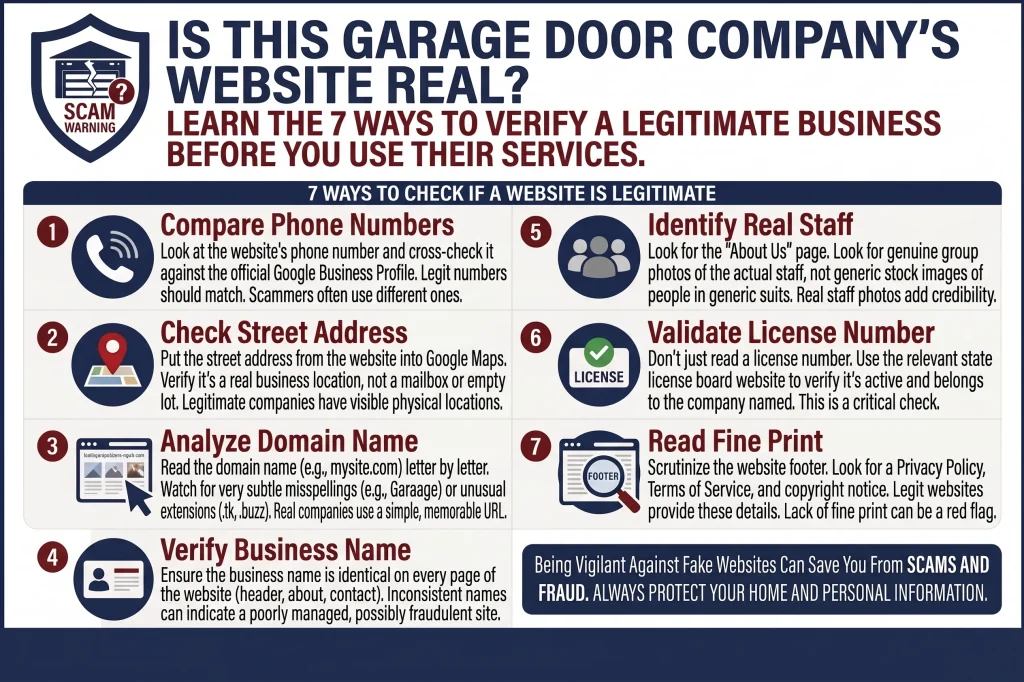
1. Compare the phone number against the Google Business Profile
The check: Open the website and note the phone number. Then search the business name on Google separately and open its Business Profile on the right side of the results. The two numbers should be identical.
Why it matters: A cloned site typically keeps the real company’s name and branding but swaps in a phone number that routes to the scammer’s call center. That number is the entire point of the operation. Everything else on the page exists to make you dial it.
What a mismatch means: It is not always fraud. Companies do change numbers, and tracking numbers used for advertising can differ legitimately. But it is always worth a pause. Call the number on the Google listing rather than the one on the site, and ask whether the other number belongs to them.
This is the first move in a broader pattern of impersonation. If you want the full picture of how these operations are constructed, read How Do Scammers Impersonate a Trusted Garage Door Company? 10 Tricks They Use. The fake-website tactic is documented rather than theoretical. The International Door Association’s scam awareness page has collected news coverage including an investigation into fake garage door websites using genuine local phone numbers to reach homeowners in a specific city.
Be extra careful when: You are in a hurry. If you are dealing with a garage door that is stuck and will not open, you are far more likely to dial the first number you see. That is exactly the condition these sites are built for.
How to check if a garage door company’s phone number is real
Search the company name on Google, open the Business Profile, and compare its phone number to the one on the website. If they differ, call the Google listing number and ask about the discrepancy before you call anything else.
2. Put the street address into Google Maps
The check: Find the physical address, usually in the footer or on the contact page. Paste it into Google Maps and switch to Street View.
Why it matters: A real garage door company needs physical space. Doors are large, springs and openers need storage, and trucks need somewhere to park. The business will have a shop, a warehouse, a yard, or at minimum a proper office. A fake operation has none of that, so it either invents an address or omits one entirely.
What you are looking for: A commercial building consistent with the business. Warning signs include a residential house, an empty lot, a mailbox rental counter inside a shipping store, or an address that Maps cannot find at all. An address that resolves to a virtual office suite in a coworking building is also worth questioning for this trade specifically.
Clopay makes the same recommendation in its guide to avoiding garage door scams, noting that scam operations frequently lack a legitimate physical showroom and that searching the website’s address on Google Maps is a practical way to confirm whether a real business location exists.
Be extra careful when: There is no address anywhere on the site. Some legitimate mobile-only operators do exist, but for a trade that stocks large inventory, a missing address deserves a direct question on the phone.
Why checking a garage door company’s address on the map works so well
An address is one of the hardest things for a fake operation to fabricate convincingly, because Street View shows you the actual building. It is the highest-value verification per second you spend.
3. Read the domain name letter by letter
The check: Look at the URL in the address bar, not the logo on the page. Read it slowly.
Why it matters: Lookalike domains rely on you recognizing the shape of a word rather than reading it. Common variations include an added or removed hyphen, a swapped word order, a plural instead of a singular, a different ending such as .net or .co in place of .com, and an added city or keyword in front of the real name.
What to do: If you know the company’s real domain, type it directly into the browser instead of searching. If you do not, check that the domain matches the business name exactly as written on the page. A company named one thing operating on a domain named something noticeably different is worth a question.
Brand impersonation through paid search and lookalike domains is common enough that the industry issues periodic warnings, including a public alert from the International Door Association.
Be extra careful when: You arrived by clicking an ad. Paid placement verifies nothing about who is advertising, and the ad headline can display one name while the destination domain is another.
How to spot a fake garage door company domain name
Compare the domain in the address bar to the business name on the page. Extra hyphens, added city names, unusual endings, and rearranged words are the most common lookalike patterns.
4. Confirm the business name is identical on every page
The check: Read the business name in the header, the footer, the About page, the contact page, and the page title in the browser tab. All five should match exactly.
Why it matters: Fake sites are frequently built from a template that gets reused across many different fake businesses. Names get changed inconsistently, so remnants of a different company name survive in the footer, a page title, or an image caption. Scam operations also deliberately rotate names to avoid accumulating reviews and complaints.
What you are looking for: Any inconsistency at all. “Garage Door Repair Pros” in the header and “GDR Services LLC” in the footer is a meaningful mismatch. So is a browser tab title referencing a completely different city or company.
A real company has one legal name and uses it everywhere, including on the invoice. When you book garage door repair with a legitimate business, the name you saw online is the name that shows up on your paperwork and on the truck.
Be extra careful when: The site uses only a generic descriptor and never states a legal business name anywhere. A real company will identify itself.
Why a garage door company’s business name should match everywhere
Template-built fake sites leave traces of other business names in footers and page titles. One consistent legal name across every page is a basic sign of a real operation.
5. Look for real people on the About page
The check: Open the About page. Look for named people, real photographs, a founding year, and specific local history.
Why it matters: Fake sites almost never name anyone. Naming a person creates a verifiable claim, and a verifiable claim is exactly what a scam operation cannot afford. Instead you get generic copy about commitment to quality, stock photos of models in clean uniforms, and no individual attached to anything.
What you are looking for: Owner or technician names you can search. Photos that look like they were taken at an actual local job site rather than in a studio. A specific founding year. Named service areas rather than a vague region. If you can find one of those people on LinkedIn or in a local business listing, that is meaningful confirmation.
Knowing who works there also sets you up for the next step, which happens at your door rather than online. The process for confirming the person who actually shows up is covered in How Do I Know If a Garage Door Tech Is Legit? 6 Checks Before You Let Them In.
Be extra careful when: Every photo appears to be stock imagery. Stock photos alone are not proof of fraud, since plenty of legitimate small businesses use them, but combined with an unnamed team and no founding year the pattern gets harder to explain. A company that has served an area for years and offers ongoing garage door maintenance usually has real photos of real work, because it has accumulated them.
How to tell if a garage door company’s About page is genuine
Look for named people, a founding year, and photographs that appear to come from actual local jobs. Generic copy with no names attached is the most common pattern on fabricated sites.
6. Verify the license number rather than just reading it
The check: Find the license number, usually in the footer. Look it up in your state or provincial licensing authority’s public database and confirm the name attached to that license matches the business name on the site.
Why it matters: A license number printed on a website proves only that someone typed a number. License numbers are public records in most jurisdictions, which makes them easy to copy onto a fake site. The verification step is the part that matters, and it is the part almost nobody performs.
What you are looking for: An exact match between the licensed entity name and the business name on the website. A license that resolves to a different company, an expired license, or a number that returns no result at all are all serious problems.
Why it matters more for large jobs: For a minor adjustment, the stakes are limited. For a full garage door installation, you are committing to a significant purchase and a warranty relationship that needs to still exist in five years. If you are at the stage of comparing options, our homeowner’s guide to picking a new garage door covers what to weigh, and understanding the average lifespan of a garage door helps you judge whether replacement is genuinely warranted.
Be extra careful when: The site displays badges and seals but no verifiable number. Trust badges are images. Anyone can add one.
How to confirm a garage door company is licensed
Look the license number up with the issuing authority, not on the company’s own website, and confirm the licensed name matches the business name exactly.
7. Read the footer and the fine print
The check: Scroll to the bottom. Read the copyright year, the service area list, the privacy policy, and any pricing banners.
Why it matters: The footer is where template-built sites break down, because it is the part nobody proofreads. It is also where the most revealing claims tend to live.
What you are looking for:
- A copyright year several years out of date, or a placeholder that was never updated
- A service area list that names dozens of cities across multiple states, which no local company can genuinely serve
- A missing or obviously copied privacy policy, sometimes still naming a different business
- A rock bottom advertised service fee displayed prominently
That last one matters more than it appears. A heavily advertised low service call fee is the standard opening for a bait-and-switch, and the mechanics of how the final number grows are broken down in Is a Cheap Garage Door Repair Ad a Scam? 8 Ways the Price Goes Up.
Give yourself a reference point: Knowing roughly what is wrong before anyone arrives makes you much harder to oversell. Our guide to why a garage door will not work and the 10 most common reasons covers the realistic causes, several of which have inexpensive genuine fixes. If a site or a technician jumps straight to a full garage door panel replacement for a symptom that reads as a sensor fault, that gap is worth a second opinion.
What a garage door company’s website footer tells you
An outdated copyright year, an implausibly large service area, a missing privacy policy, and a prominent rock bottom fee are the four footer signals most worth checking.
Real website vs. fake website: what to compare
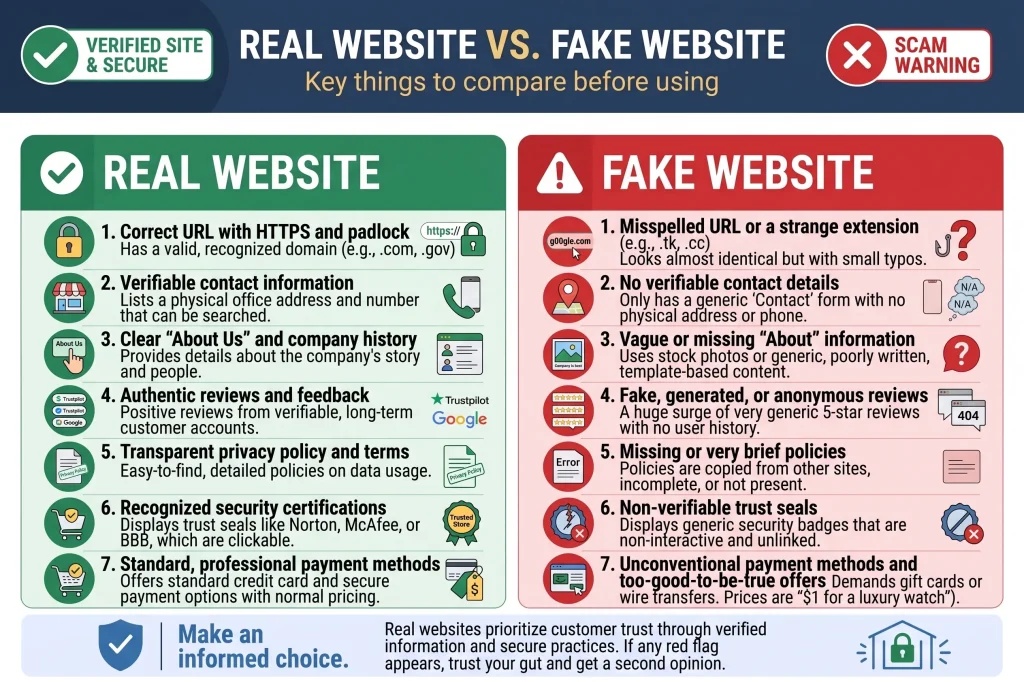
|
What you check |
Real company website |
Fake or cloned website |
|
Phone number |
Matches the Google Business Profile exactly |
Differs from the Google listing, routes to a call center |
|
Street address |
Maps to a shop, yard, or office visible in Street View |
Vacant lot, mailbox store, house, or no address at all |
|
Domain name |
Matches the business name cleanly |
Extra hyphens, added city, unusual ending, rearranged words |
|
Business name |
Identical in header, footer, page titles, and invoice |
Inconsistent across pages, or generic with no legal name |
|
About page |
Named people, founding year, real local photos |
No names, stock photos, generic commitment language |
|
License number |
Resolves to the same business name in the public database |
Missing, expired, or resolves to a different entity |
|
Service area |
A realistic local radius |
Dozens of cities across multiple states |
|
Pricing |
Written estimate offered, no headline gimmick |
Prominent rock bottom service fee as the main hook |
The bottom line
None of these seven checks takes long, and you do not need all seven. Run the phone number check and the address check first, because together they catch most fake sites in under two minutes. If both pass, you are almost certainly dealing with a real company. If either fails, keep going before you dial.
The larger point is that verification is normal and you are allowed to do it. Any legitimate business expects a homeowner to confirm who they are calling, and none of us are offended by the question. If you ever want to confirm that a site claiming to be Good Guys Garage Door Service actually is us, call the number on our Google listing and ask.
Want to skip the guesswork? Get a free quote from us directly and we will confirm the technician’s name and arrival window in writing before we come out.