
You can confirm a garage door technician is legitimate in about two minutes, and you should do it before anyone comes inside. Look at the vehicle for company markings, ask for photo identification and the name of the company, and ask to see a work order that matches the appointment you booked. If anything does not line up, close the door and call the company’s published number to confirm they dispatched someone to your address. A real technician expects all of this and will wait. Refusal to provide identification is not a scheduling inconvenience, it is your answer.
Key takeaways
- Run the checks before you open the door fully or step aside. Verification is much harder once someone is inside.
- The single strongest check is the callback: dial the company’s published number yourself and confirm the dispatch.
- An unmarked vehicle plus no identification plus no work order is a pattern, and it is the pattern reported most often in these cases.
- You are never obligated to let anyone into your home, regardless of whether you booked an appointment.
- A properly stocked truck is a quiet but reliable signal. Impersonators travel light because they do not intend to complete real repairs.
- If you feel unsafe at any point, do not attempt to confront or detain anyone. Close the door and call your local non-emergency police line.

1. Look at the vehicle before you open the door
The check: Before answering, look at what is parked outside. A legitimate garage door company arrives in a marked vehicle carrying the business name, usually a phone number, and often a license number.
Why it matters: Vehicle branding is expensive and permanent, which is exactly why real companies invest in it and impersonators do not. A wrapped or lettered truck ties the vehicle to a business that can be found, reviewed, and complained about. An unmarked van ties it to nobody.
What you are looking for: The company name matching the one you booked with. Not a similar name, not a magnetic sign that looks recently applied, and not a plain vehicle with no identification. Magnetic door signs are worth noticing, since they can be swapped in minutes.
Where this comes from: This is a documented pattern rather than a hypothetical one. The International Door Association’s scam awareness resources collect news coverage of reported cases, including an incident in which a repairman arrived in an unmarked truck and asked to come inside a homeowner’s residence.
Important caveat: Some legitimate small operators genuinely do run modest vehicles, and a subcontractor may drive their own truck. An unmarked vehicle alone is not proof of anything. It simply means the remaining five checks matter more.
The vehicle is one visible layer of a much broader impersonation pattern, which is covered in full in How Do Scammers Impersonate a Trusted Garage Door Company? 10 Tricks They Use.
What a legitimate garage door service truck looks like
Permanent lettering or a vehicle wrap with the company name and phone number, often a license number, and visible stocked inventory rather than an empty cargo area.
2. Ask for photo identification and the company name
The check: Before anyone comes in, ask two things: may I see your identification, and which company are you with. Compare both against the appointment you booked.
Why it matters: This is the moment the entire impersonation either holds or collapses, and it costs you fifteen seconds. A technician working for a real company carries identification, expects to be asked, and is not offended by the question.
What you are looking for: A company ID badge, or at minimum a driver’s license plus a company name stated confidently and immediately. Hesitation before naming the employer is meaningful. So is a name that differs even slightly from the one you called.
On feeling rude: Almost everyone hesitates to ask, and that hesitation is precisely what the tactic depends on. Asking a stranger to identify themselves before entering your home is not rude. It is the normal thing to do, and anyone who reacts badly to it has told you something useful for free.
Brand and identity impersonation are common enough in this trade that the industry issues public warnings about it, including an alert from the International Door Association.
How to ask a garage door technician for ID without it being awkward
Ask while the door is still partly closed, before stepping aside: “Before we start, can I see your ID and confirm which company you’re with?” Framing it as a step in the process rather than an accusation makes it routine.
3. Ask to see the work order and check it against your booking
The check: Ask for the work order, job ticket, or dispatch record. It should carry your name, your address, and a description of the problem you actually reported.
Why it matters: A work order links the person at your door to a specific booking inside a real company’s system. An impersonator responding to a call they intercepted, or arriving unsolicited, usually has nothing to show, or produces something generic with no customer details.
What you are looking for: Your name spelled correctly, your address, and a fault description matching what you described on the phone. If you called about a door that will not close and the ticket says general inspection, ask why.
The natural next step: The work order should also lead directly into a written estimate before any work begins. That single document defeats most pricing problems, and the ways a number moves without one are broken down in Is a Cheap Garage Door Repair Ad a Scam? 8 Ways the Price Goes Up.
Give yourself context: Knowing roughly what is wrong makes it much easier to tell whether the ticket matches reality. Our guide to why a garage door will not work and the 10 most common reasons covers the realistic causes behind the most common symptoms. When you book garage door repair with a real company, the fault you described is the fault written on the ticket.
What should be on a garage door work order
Your name, your address, the reported fault, the scheduled window, and the company’s legal name. Generic paperwork with no customer details is not a work order.
4. Call the company’s published number and confirm the dispatch
The check: If anything at all feels off, close the door and call the company yourself. Do not use a number the person at your door gives you, and do not call the number from the ad you clicked. Use the number published on the company’s website or Google Business Profile.
Why it matters: This is the strongest check available to you, because it routes around everything the impersonator controls. They can produce a badge, a magnetic sign, and a printed ticket. They cannot make a real company’s dispatcher confirm a job that does not exist.
What to ask: Did you send a technician to my address today, and what is that technician’s name? Both answers should come back immediately and should match the person outside.
Getting the right number: The number matters more than anything else in this step, and getting it from the wrong place undoes the whole check. The process for confirming you have the real company’s real contact details is covered in Is This Garage Door Company’s Website Real? 7 Ways to Check.
When this matters most: Emergencies, because that is when people skip it. If you are dealing with a garage door that is stuck and will not open, the urgency of the situation is the leverage being used against you. Two minutes on the phone is worth it.
A note on safety: You do not need to explain yourself, argue, or confront anyone. Close the door, make the call, and if the answers do not line up, do not reopen it. If you feel genuinely unsafe, call your local non-emergency police line. Do not attempt to detain anyone or photograph them in a way that provokes a confrontation.
How to confirm a garage door technician was actually dispatched
Call the number published on the company’s website or Google listing, not one provided at your door, and ask whether they sent a technician to your address and what that technician’s name is.
5. Ask for license and insurance, then verify rather than read
The check: Ask for the license number and proof of insurance. Then actually look the license up with your state or provincial licensing authority and confirm the name on it matches the company.
Why it matters: A number printed on a business card or an invoice proves that someone typed a number. License numbers are public records in most jurisdictions, which makes them straightforward to copy. Reading the number is not verification. Looking it up is.
Why insurance specifically matters to you: If an uninsured worker is injured in your garage, or damages your door, your vehicle, or your home, you may have far less protection than you assume. This is not an abstract compliance issue. It is the part of the check that protects your property.
What to ask for: A certificate of insurance issued by the carrier rather than a number written on paperwork. Reputable companies produce these routinely and are not surprised by the request.
Clopay’s guidance on avoiding garage door scams makes the same recommendation, advising homeowners to confirm that a company is properly licensed, bonded, and insured before allowing work to begin.
Where this matters most: For a small adjustment, the exposure is limited. For a full garage door installation, you are committing to a significant purchase plus a warranty relationship that needs to still exist years from now. If you are weighing replacement, the average lifespan of a garage door is a useful reference for judging whether yours is genuinely near the end, and our homeowner’s guide to picking a new garage door covers what to weigh once it is.
How to verify a garage door technician’s license
Look the number up in the issuing authority’s public database rather than accepting it as printed, and confirm the licensed entity name matches the company name exactly.
6. Look at the uniform, the tools, and what is in the truck
The check: Once the first five checks have passed, take thirty seconds to notice how the technician is equipped.
Why it matters: This is the softest signal on the list, and it is also difficult to fake at short notice. Real garage door work requires specific inventory, and companies that do it every day carry that inventory as a matter of routine.
What a working truck carries: Torsion springs in several sizes, cables, rollers, hinges, brackets, photo eye sensors, remotes and batteries, and opener parts. There is a practical reason for this. A door that reverses before closing frequently needs nothing more than a sensor realignment or a replacement sensor, and a remote that has stopped working is often solved with a battery or a reprogram. A technician who genuinely does this work daily carries the parts for the most common jobs, because coming back tomorrow costs them money.
What is worth noticing: A nearly empty cargo area on a truck that arrived to perform repairs. Consumer-grade tools rather than trade tools. A technician who cannot answer a straightforward question about the mechanism.
The honest limitation: None of this is conclusive. A tech at the end of a long day may be low on stock, and a specialist arriving for a scheduled garage door panel replacement will carry that panel rather than a general repair load. Treat it as a supporting signal, not a verdict.
A better long-term move: The most reliable way to avoid this situation entirely is to establish a relationship with a company before an emergency. Booking routine garage door maintenance means that when something does fail, you already know who to call and what their truck looks like.
What tools and parts a real garage door technician carries
Springs in multiple sizes, cables, rollers, hinges, sensors, remotes, and opener components. Trade-grade tools rather than consumer ones. An essentially empty truck on a repair call is worth noticing.
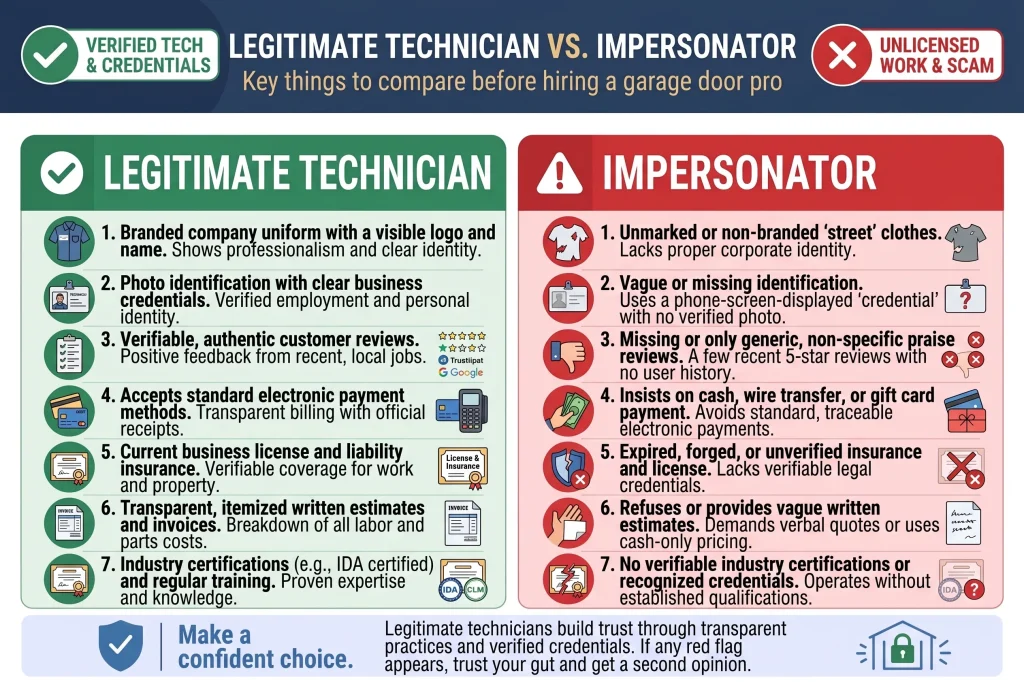
Legitimate technician vs. impersonator: what to compare
|
What you check |
A legitimate technician |
An impersonator |
|
Vehicle |
Permanent lettering or wrap, company name and number |
Unmarked, or a magnetic sign that can be swapped |
|
Identification |
Produces ID without hesitation, expects the question |
Deflects, delays, or has none |
|
Company name |
Stated immediately, matches your booking |
Vague, generic, or slightly different |
|
Work order |
Your name, address, and reported fault |
Generic paperwork or nothing at all |
|
Callback |
Dispatcher confirms the job and the technician’s name |
No record of the job, or no answer |
|
License |
Verifiable in the public database under the same name |
Missing, expired, or resolves elsewhere |
|
Insurance |
Certificate available from the carrier |
A number on paper, or an excuse |
|
Truck stock |
Springs, cables, rollers, sensors, opener parts |
Sparse or empty cargo area |
The bottom line
Five of these six checks happen before anyone crosses your threshold, and together they take about two minutes. The one that matters most is the callback, because it is the only check an impersonator has no way to influence. Everything else can be printed, purchased, or bluffed. A dispatcher confirming a real job in a real system cannot.
The habit worth building is smaller than it sounds: verify first, then open the door. Every legitimate technician in this trade expects it, and the ones worth hiring will tell you so themselves. If you ever want to confirm that someone at your door is really from Good Guys Garage Door Service, call the number on our Google listing and ask. We would much rather take that call than help someone clean up afterward.
Want to know exactly who is coming before they arrive? Book with us and get a free quote, and we will confirm your technician’s name and arrival window in writing before we come out.