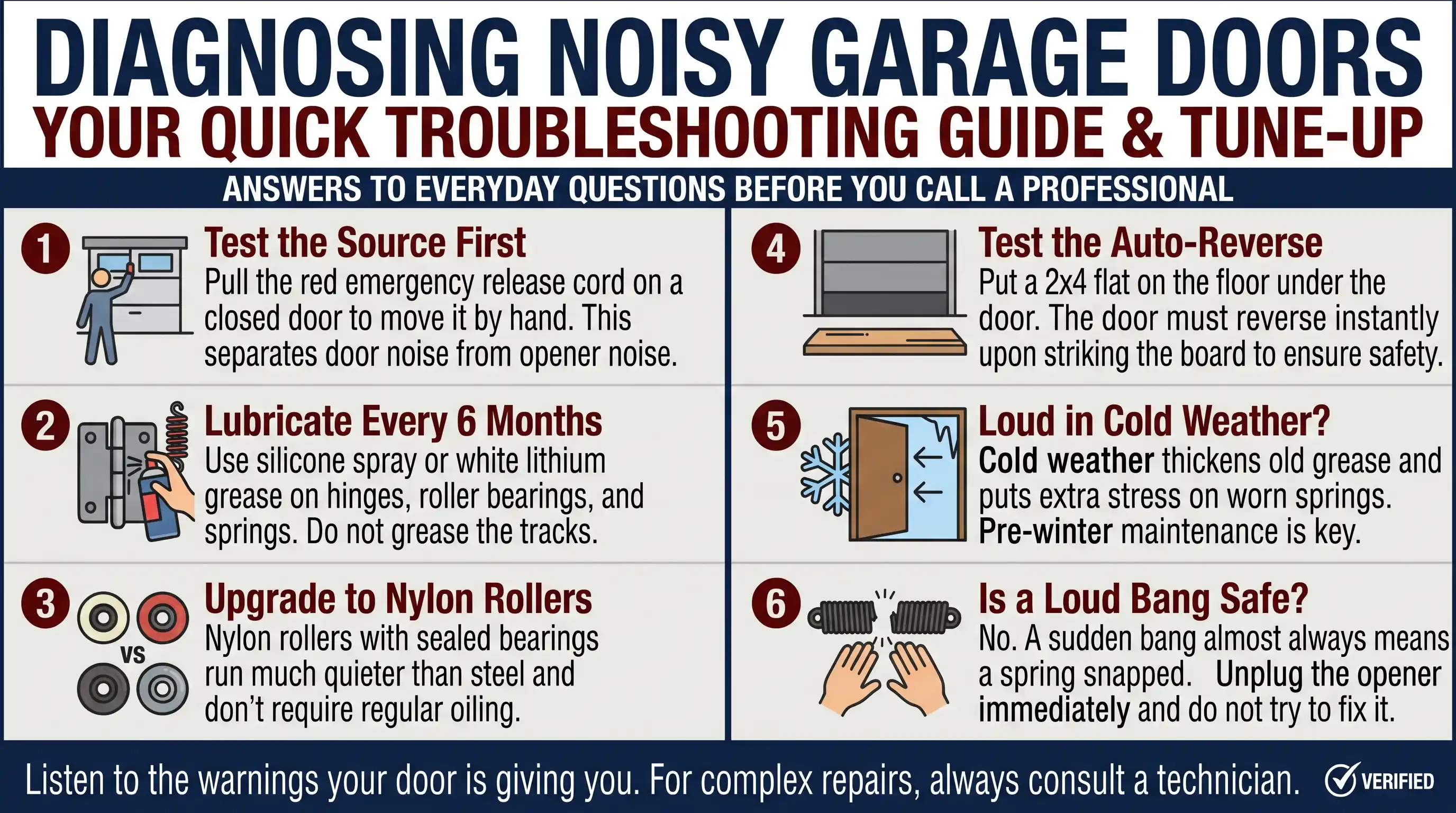
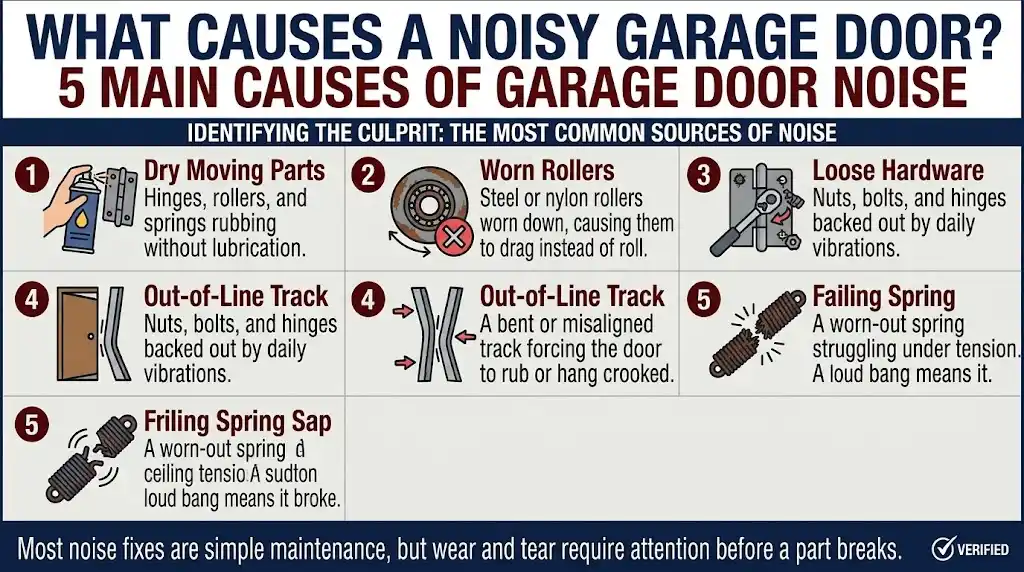
A noisy garage door is almost always caused by one of five things: dry moving parts, worn rollers, loose hardware, a track that’s out of line, or a spring that’s wearing out. The type of sound tells you which one. Squeaking usually means the door needs lubrication. Grinding points to worn rollers or stripped opener gears. Rattling means loose nuts and bolts. Scraping means the door is rubbing or hanging crooked. Popping or a sudden loud bang points to the springs, and that’s the one noise you should never try to fix yourself.
Key Takeaways
- Squeaking is the most common garage door noise. The right garage door lubricant fixes most cases in under an hour.
- Grinding means something is dragging instead of rolling. The usual culprits are worn roller bearings or gears inside the opener.
- Rattling almost always comes from loose hardware that daily vibration has shaken free.
- Popping from the springs is a warning sign. A loud bang usually means a spring has already broken.
- Never adjust, loosen, or replace springs, cables, or bottom brackets yourself. They hold the door’s weight under extreme tension.
- Find the source first. With the door closed, pull the emergency release and move the door by hand to tell door noise from opener noise.
1. Squeaking or Squealing
Why does my garage door squeak, and how do I stop it?
A squeak or squeal almost always means metal parts are rubbing without enough lubrication. It’s the most common noise homeowners call us about, and usually the easiest to fix.
Symptom: A high-pitched squeak that repeats as each hinge and roller flexes. It’s often loudest when the door starts moving or reaches the top.
Most likely cause: Dry hinge pins, dry bearings on steel rollers, or dry torsion spring coils. Worn hinges whose pin holes have stretched into ovals can also squeak.
How to fix it:
- Close the door and unplug the opener so no one runs it while you work.
- Wipe dust and old gunk off the hinges and rollers with a dry rag.
- Apply a silicone spray or white lithium grease made for garage doors to three places: the hinge pins, the roller bearings, and the bearing plates at each end of the spring shaft.
- Add a light coat along the spring coils. Don’t touch the winding cones or set screws at the ends of the spring.
- Keep lubricant off the tracks and off the nylon wheel of nylon rollers.
- Run the door up and down a few times, then wipe away any drips.
Call a pro if:
- The squeak comes back within a few weeks.
- A hinge is cracked or has an oval pin hole.
- The springs look rusty or stretched.
For product picks and a part-by-part walkthrough, read Why Does My Garage Door Squeak? 7 Causes and How to Lubricate It the Right Way.
2. Grinding
How to fix a garage door that grinds when it opens
Grinding means something that should roll or turn is dragging instead. On the door, that’s usually a worn roller or a failing bearing. Overhead, it’s often a worn gear inside the opener.
Symptom: A rough, gritty, metal-on-metal sound, sometimes with a shudder. It tends to get louder over a few weeks.
Most likely cause: Steel rollers whose bearings have worn out or seized, so they slide instead of spin. The other usual suspects are cracked or wobbling rollers, grit packed into the tracks, and a stripped drive gear in the opener.
How to fix it:
- With the door fully closed, pull the red emergency release and lift the door a few feet by hand.
- If the grinding stops, the opener is the source (see sound #8).
- If it keeps going, it’s the door.
- Lower the door and reconnect the trolley.
- Watch each roller as the door moves. Any roller that won’t spin, wobbles, or has flat spots needs replacing.
- Wipe the tracks clean with a damp rag. Don’t grease them.
- Lubricate the bearings on steel rollers. If the rollers are worn, nylon rollers with sealed ball bearings are a quieter replacement.
Call a pro if:
- The worn rollers are in the bottom brackets.
- A roller has jumped out of the track.
- The opener keeps grinding while the door is disconnected.
To tell a worn roller from a worn opener gear by sound alone, see Why Is My Garage Door Making a Grinding Noise? 6 Causes and How to Fix Each One.
3. Rattling
How to fix a garage door that rattles
Rattling almost always means hardware has worked loose. A door that opens and closes several times a day goes through well over a thousand cycles a year. That vibration slowly backs out nuts, bolts, and screws.
Symptom: A loose, clattering rattle as the door moves. Sometimes the door also shakes in its tracks.
Most likely cause: Loose hinge bolts, loose track brackets or lag screws, or a loose opener mounting bracket on the ceiling.
How to fix it:
- Unplug the opener and close the door.
- Use a socket wrench to snug up the bolts on each hinge and on the brackets that hold the tracks to the wall.
- Check the bracket that holds the opener to the ceiling.
- Tighten until snug and no further. Cranking down hard can strip the screw holes or pull bolts through the door skin.
Call a pro if:
- The loose part is on a bottom bracket, a cable drum, or the plate that anchors the springs. These parts are tied into the spring system and should never be loosened or tightened by a homeowner.
- Bolts keep spinning in stripped holes.
4. Scraping or Rubbing
Why is my garage door scraping against the track?
Scraping means part of the door is rubbing somewhere it shouldn’t. The usual reason is a bent or misaligned track, or a door that’s hanging crooked.
Symptom: A dragging or scraping sound in the same spot on every trip. Sometimes you’ll also see a gap at the floor on one side.
Most likely cause:
- A bent or misaligned track
- Rollers rubbing the edge of the track
- The door rubbing its weatherstripping or side trim
- A lift cable that has frayed or slipped, so one side of the door sits lower
How to fix it:
- Sight down each track for dents, bends, or gaps where one section meets the next.
- Clean out dirt and debris. The home improvement editors at Bob Vila recommend keeping tracks clean but free of lubricant, because grease in the track just collects grit.
- Check the weatherstripping along the sides and top of the door for spots where the door is catching.
Call a pro if:
- A track is bent.
- The door hangs crooked.
- A cable looks frayed or loose on its drum. A damaged cable is a safety hazard, so keep the door parked until you’ve had garage door cable repair.
A door that binds in its tracks can also trip the opener’s safety system. That’s one common reason for a garage door that reverses before closing.
5. Popping or Creaking From the Springs
Why do garage door springs pop or creak?
Dry springs creak, and aging springs pop as the coils bind and release. A squeaky spring can usually be quieted with lubricant. Popping that gets louder over time is different: it’s a sign the spring is wearing out.
Symptom: A sharp pop, creak, or groan from the long spring above the door. It’s often loudest on cold mornings.
Most likely cause:
- Dry coils.
- Springs near the end of their rated life. Standard springs are commonly rated for about 10,000 open-and-close cycles.
- Cold weather. Winter cold snaps in Monmouth County add stress to springs that are already tired.
- Worn hinges. These can also pop as the panels shift.
How to fix it:
- Add a light coat of garage door lubricant along the spring coils.
- Run a balance test. With the door closed, pull the emergency release, lift the door about halfway by hand, and let go.
- A balanced door stays put.
- If it drifts down or shoots up, the springs are out of balance.
- If the door is hard to lift at all, stop and lower it gently.
The Door & Access Systems Manufacturers Association (DASMA) makes the same distinction. Spring squeaks often come from normal use and can be lubricated first, but repairs to the spring system belong with trained technicians.
Call a pro if:
- You see gaps or rust in the coils.
- The door fails the balance test.
- The door suddenly feels heavy.
For the full list of signs that come before a spring fails, read Why Did My Garage Door Make a Loud Bang? 5 Spring Warning Signs You Shouldn’t Ignore.
6. A Loud Bang
What a loud bang from your garage door usually means
A sudden bang like a gunshot almost always means a torsion spring has snapped, and it often happens when no one is using the door. Afterward, the door usually won’t open, or the opener lifts it only a few inches before stopping.
Symptom: One loud bang, then a door that feels extremely heavy, won’t open, or hangs crooked. Look up at the spring above the door and you’ll often see a clear gap in the coil.
Most likely cause: A torsion spring that reached the end of its life, often weakened by rust. Less often, a lift cable snaps.
What to do right now:
- Stop using the opener and unplug it. Running it against a door with no working spring can burn out the motor or strip its gears.
- If the door is closed, leave it closed.
- If the door is open, keep people, pets, and cars out from under it. Don’t try to close it by hand.
- Don’t touch the springs, cables, or brackets.
If your door uses extension springs along the tracks, check that a safety cable runs through each spring. Without one, a broken extension spring can whip loose.
Call a pro: Always. Our rule of thumb from the field is that when one spring in a pair breaks, you replace both, because the other one is usually close behind. Book broken garage door spring repair instead of turning it into a weekend project. If your car is stuck inside in the meantime, here’s what to do when your garage door is stuck and won’t open.
7. Chain Slap or Clanking
How to fix a loud garage door opener chain
If you have a chain-drive opener and hear clanking or slapping overhead, the chain is usually loose or dry.
Symptom: A rhythmic slap or clank from the rail above the car. The chain visibly sags or bounces as the door moves.
Most likely cause: Chain tension that has loosened over time, a dry chain and sprocket, or a worn trolley.
How to fix it:
- Unplug the opener.
- Adjust the chain tension using the steps in your opener’s manual. A chain that’s too loose slaps, and one that’s too tight strains the motor.
- Lubricate the chain if your manual calls for it.
Call a pro if:
- The chain loosens again quickly.
- The trolley is worn or cracked.
- The sound is coming from inside the motor head.
Garage door manufacturer Clopay puts a chain drive that sounds like it’s dragging in the call-an-expert category. If noise is your main complaint, a belt-drive opener is noticeably quieter than any chain.
8. Humming, Buzzing, or Clicking From the Opener
Why does my garage door opener hum but not open?
A hum with no movement means the motor is getting power but can’t move the door. A brief hum often points to broken springs or a locked door. A hum that runs for several seconds usually means stripped gears inside the opener.
Symptom: The opener hums, buzzes, or clicks when you press the button, but the door doesn’t move or moves only slightly.
Most likely cause:
- Brief hum: a broken spring, or the door’s manual slide lock is engaged.
- Longer hum: a stripped drive gear, or the door isn’t connected to the trolley.
- Repeated clicking: can point to a failing relay on the opener’s circuit board.
How to fix it:
- Check that the manual lock bar on the inside of the door is fully open.
- Make sure the trolley is connected to the door.
- Look at the spring above the door for a gap in the coil.
Call a pro if:
- The spring is broken.
- The door feels heavy when you lift it by hand.
- The gears are stripped.
If a humming opener has left your car trapped inside, that’s a job for emergency garage door repair. If the noise has already turned into a door that won’t move at all, our guide to the 10 most common reasons a garage door won’t work covers the rest of the checklist.
9. Vibration and Rumbling Inside the House
How to stop garage door noise from carrying into your house
If you can hear the door from the bedroom above the garage, there are two usual reasons. Either the opener’s vibration is traveling through the ceiling joists, or an older chain drive and a thin door are amplifying every movement.
Symptom: A low rumble or hum you can feel in the floor or walls of the rooms next to or above the garage.
Most likely cause:
- An opener bolted straight to the joists with no isolation
- A chain-drive opener
- Worn steel rollers
- A thin, single-layer door that acts like a drum
How to fix it:
- Add rubber isolator pads or a vibration kit between the opener’s mounting bracket and the ceiling.
- Switch to nylon rollers (see sound #2).
- Consider a belt-drive opener if yours is an older chain drive.
Call a pro if: the opener is loose on its mount, or you’re weighing an upgrade. An insulated door dampens sound noticeably. A custom garage door lets you choose an insulated, multi-layer construction that matches your home. Our homeowner guide to picking a new garage door walks through the options.
DIY-Safe vs. Call a Pro: Garage Door Noises at a Glance
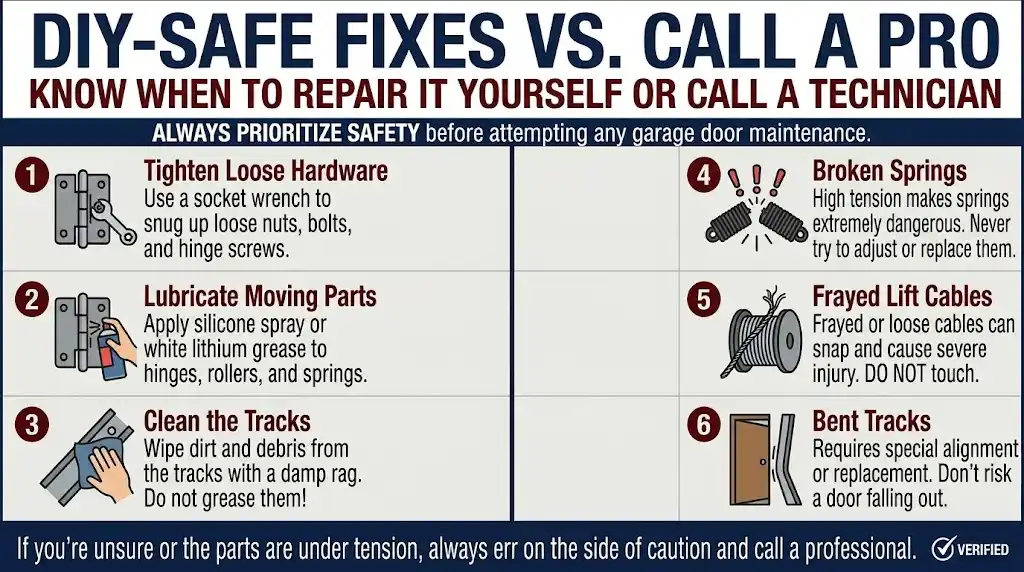
Most noise fixes are simple, but anything connected to the springs is not. The DIY editors at Family Handyman make the same point: on doors with torsion springs, the bottom brackets that hold the lowest rollers stay under constant tension. A homeowner should never unbolt them.
After any DIY fix, test the auto-reverse. Lay a 2×4 flat on the floor under the door and close it. The door should reverse as soon as it touches the board.
When you do call someone, confirm they’re a registered New Jersey contractor, and be wary of cheap garage door repair ad scams.
| Sound | Most likely cause | DIY-safe fix | Call a pro when |
| Squeaking | Dry hinges, rollers, or springs | Lubricate hinges, roller bearings, and springs | The squeak returns within weeks, or a hinge is cracked |
| Grinding | Worn rollers or bearings, stripped opener gear | Clean tracks, lubricate steel bearings, replace upper rollers | Bottom rollers are worn, a roller left the track, or the opener grinds |
| Rattling | Loose hinge, track, or opener hardware | Snug up hinge and track bolts | The loose parts are on bottom brackets, drums, or spring plates |
| Scraping | Bent track, crooked door, damaged cable | Clean tracks, check weatherstripping | A track is bent, the door hangs crooked, or a cable is frayed |
| Popping | Dry or aging springs, worn hinges | Lubricate springs, run a balance test | Coils show gaps or rust, or the door fails the balance test |
| Loud bang | Broken spring or cable | Unplug the opener and leave the door alone | Always |
| Chain slap | Loose or dry opener chain | Adjust tension per the manual, lubricate the chain | The chain keeps loosening, or the trolley is worn |
| Humming or clicking | Broken spring, engaged lock, stripped gear | Check the lock bar and trolley connection | The door is heavy by hand, or the gears are stripped |
| Vibration | Opener mounted to joists, chain drive, thin door | Add isolator pads, switch to nylon rollers | You’re upgrading the opener or the door |
Don’t Ignore What Your Garage Door Is Telling You
A noisy garage door is an early warning, not just an annoyance. Most squeaks, rattles, and grinding can be fixed with lubrication, tightening, or new rollers. Popping and banging are different. They point to the springs, and springs are never a DIY job. If your door is older and several parts are failing at once, compare the repair cost against the average lifespan of a garage door before you decide.
Good Guys Garage Door Service is a veteran-owned, residential-only garage door company based in Marlboro Township. We serve homeowners across Monmouth County, including Freehold, Howell, and Middletown, plus nearby East Brunswick. Our technicians diagnose the noise, give you a clear price before any work begins, and offer same-day service when you need it. Veterans and seniors get 10% off.
Book your free estimate today or call (732) 299-3428, Monday through Saturday, 8 AM to 6 PM.