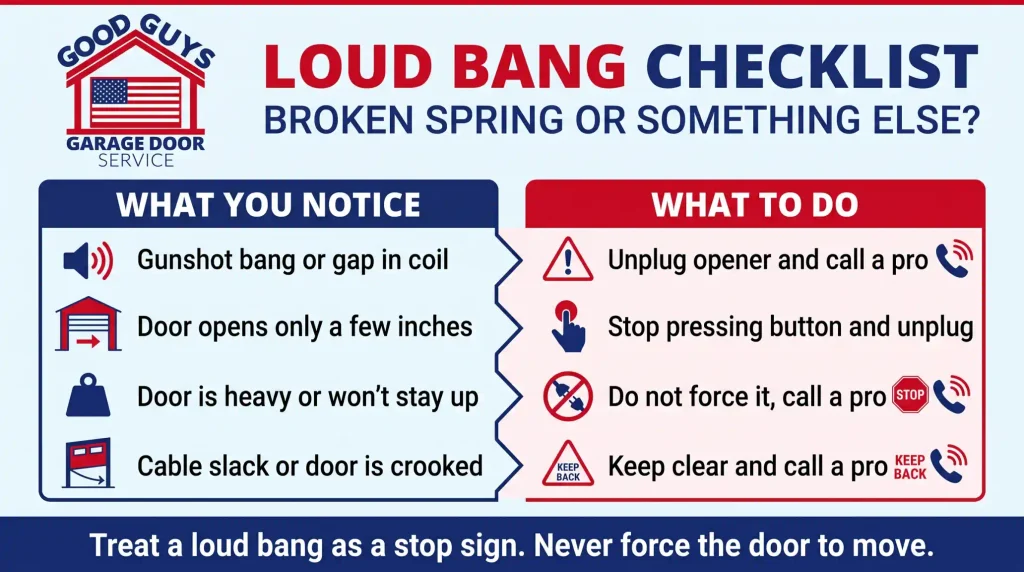
A loud bang from your garage, especially one that sounds like a gunshot, almost always means a garage door spring has snapped. Torsion springs are wound tightest when the door is closed, so they often break while the door is sitting still. Check for five warning signs: a gap in the spring coil, a door that opens only a few inches, a door that feels extremely heavy, loose or slack cables, and rust or stretched coils on the remaining spring. If you see any of them, stop using the door, unplug the opener, and call a pro. Spring replacement is never a DIY job.
Key Takeaways
- A gunshot-like bang from the garage is usually a broken spring, even if no one was using the door.
- Stop using the door and unplug the opener. Running it against a broken spring can burn out the motor or strip its gears.
- Don’t pull the emergency release with the door open. Without a working spring, the door can come down hard.
- Five signs confirm a broken or failing spring: a gap in the coil, a door that opens only a few inches, a heavy door, slack cables, and rust or stretched coils.
- When one spring in a pair breaks, replace both. The other one is usually close behind.
- Never replace or adjust a spring yourself. Springs, cables, and bottom brackets hold the door’s weight under extreme tension.
What That Loud Bang Usually Means
Why a garage door spring breaks with a loud bang
A torsion spring stores a huge amount of energy to help lift your door. When the steel finally fails, that energy releases all at once, and the coil unwinds violently around its shaft. The result is a sharp crack that most homeowners mistake for a gunshot, a firecracker, or something falling in the garage.
Because torsion springs are wound tightest when the door is closed, they often snap while the door is sitting still. That’s why so many people hear the bang overnight or while they’re inside the house, then discover the next morning that the door won’t open.
A broken torsion spring is the most likely cause, but a few other things can make a loud bang:
- A snapped extension spring on doors that have springs along the side tracks
- A lift cable snapping
- The door slamming down, often because a spring has weakened
- A roller popping out of the track
A loud bang is the most urgent of the nine sounds we cover in What Causes a Noisy Garage Door? 9 Sounds and What Each One Means, and it’s the one you should never try to fix yourself.
What to Do Right After You Hear the Bang
What to do if your garage door spring breaks
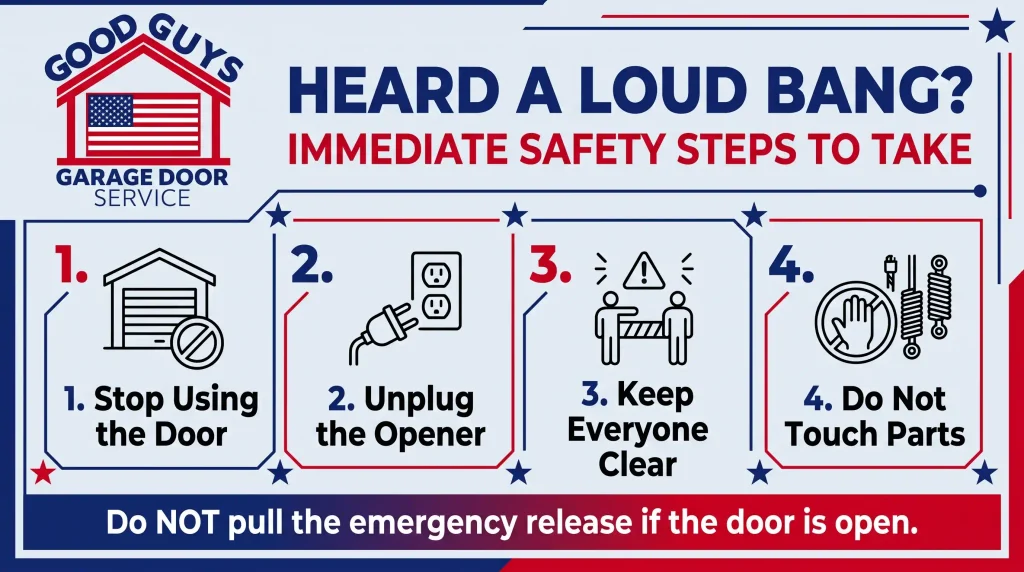
Stop using the door until a technician checks the springs. Here’s how to keep everyone safe in the meantime:
- Don’t press the opener button again.
- Unplug the opener so no one else tries to run it.
- If the door is closed, leave it closed.
- If the door is open, keep people, pets, and cars out from under it. Don’t pull the emergency release, because without a working spring, the door can come down hard.
- Don’t touch the springs, cables, drums, or bottom brackets.
- Take a photo of the spring from the floor. It helps the technician bring the right parts.
If your car is trapped inside, or the door is stuck open and you can’t secure your home, that’s the time to call for emergency garage door repair. For more on your options while you wait, see what to do when your garage door is stuck and won’t open.
1. A Gap in the Spring Coil
How to tell if a garage door torsion spring is broken
The fastest way to confirm a broken torsion spring is to look at the spring on the metal shaft above the door. A broken spring has a clear gap, usually a few inches wide, where the coil snapped and unwound.
Symptom: A visible gap in the coil, or a spring that looks like two separate pieces. On a door with two springs, one may look normal while the other is split.
What it means: The spring has snapped, and the door has lost some or all of its lifting help.
What to do:
- Look from the floor, or from a ladder set well to the side of the spring.
- Don’t touch the spring, the winding cones at its ends, or the set screws.
- If your door has extension springs along the side tracks instead, look for a spring hanging loose or lying on the floor.
Call a pro: Always. A spring with a gap in it needs broken garage door spring repair before the door moves again. If your door has two springs and only one broke, our rule of thumb from the field is to replace both at once.
2. The Door Opens Only a Few Inches, or the Opener Strains
Why a garage door only opens a few inches after a loud bang
When a spring breaks, the opener suddenly has to lift the door’s full weight. Most openers sense the extra resistance and stop or reverse after a few inches. You’ll often hear the motor hum or strain while it tries.
Symptom: The door lifts a few inches and stops, reverses, or jerks. The opener hums, runs longer than usual, or sounds like it’s struggling.
What it means: The opener is trying to do the springs’ job, and its safety settings are stopping it.
What to do:
- Stop pressing the button.
- Unplug the opener. Repeated attempts can burn out the motor or strip the drive gear.
- Look for a gap in the spring (sign #1).
Call a pro: if you see a broken spring, or if the opener keeps straining. If the springs look intact and the door still won’t lift, the problem may be somewhere else, and our guide to the 10 most common reasons a garage door won’t work covers the other causes.
3. The Door Feels Extremely Heavy or Won’t Stay Halfway
How to test garage door spring balance
Springs do almost all the lifting. With healthy springs, a door feels light enough to lift by hand and stays put when you let go halfway. A door that feels like dead weight, or drops when you let go, has a broken or badly worn spring.
Symptom: The door is hard to lift, slams shut, closes faster than it used to, or won’t stay in place halfway open.
What it means: One or both springs have broken or lost tension. A typical garage door can weigh a couple hundred pounds, and without springs, you’re lifting all of it.
What to do:
- If you heard a bang or see a gap in the spring, skip the test. Leave the door closed and call a pro.
- If you’re checking for early wear, run a balance test:
- With the door closed, pull the emergency release.
- Lift the door about halfway by hand and let go.
- A balanced door stays put. If it drifts down or shoots up, the springs are worn or out of adjustment.
- If the door is hard to lift at all, stop, lower it gently, and don’t force it.
Call a pro: if the door fails the balance test or feels heavy.
4. Loose Cables or a Door Hanging Crooked
Why garage door cables go slack after a spring breaks
The lift cables stay tight only while the springs are pulling on them. When a spring breaks, that tension disappears. A cable can go slack, unwind, or jump off its drum, leaving one side of the door lower than the other.
Symptom: A cable hanging loose near the bottom corner of the door, a cable that has come off the drum at the end of the spring shaft, or a door that sits crooked with a gap under one side.
What it means: The spring system has failed, or a cable has frayed or snapped on its own.
What to do:
- Don’t use the door.
- Don’t touch the cables, drums, or bottom brackets.
- Keep people clear, because a crooked door can bind in the track and fall.
Call a pro: Always. A slack or frayed cable needs garage door cable repair along with the spring, since a cable that has jumped its drum often gets kinked or frayed in the process.
5. Rust, Stretched Coils, or Popping From the Other Spring
Warning signs a garage door spring is about to break
These are the signs to catch before you hear the bang. Rust, coils that look stretched or unevenly spaced, and loud popping or creaking all point to a spring near the end of its life. They matter most on the spring that didn’t break, because paired springs usually wear out at the same rate.
Symptom: Orange rust on the coils, uneven spacing between coils, or popping and creaking from above the door. You may also notice a door that feels a little heavier every month.
What it means: The spring is close to the end of its rated life.
What to do:
- Add a light coat of garage door lubricant along the coils to slow rust.
- Run a balance test once a month (see sign #3).
- Schedule a replacement before the spring breaks.
Call a pro: to replace worn springs on your schedule, not the spring’s. If the sound from above the door is closer to grinding than popping, the shaft bearings or cables may be involved, and Why Is My Garage Door Making a Grinding Noise? 6 Causes and How to Fix Each One explains what to look for.
Torsion vs. Extension Springs
How to tell which type of garage door spring you have
Garage doors use one of two spring systems. Both can break with a loud bang, but they fail in different ways.
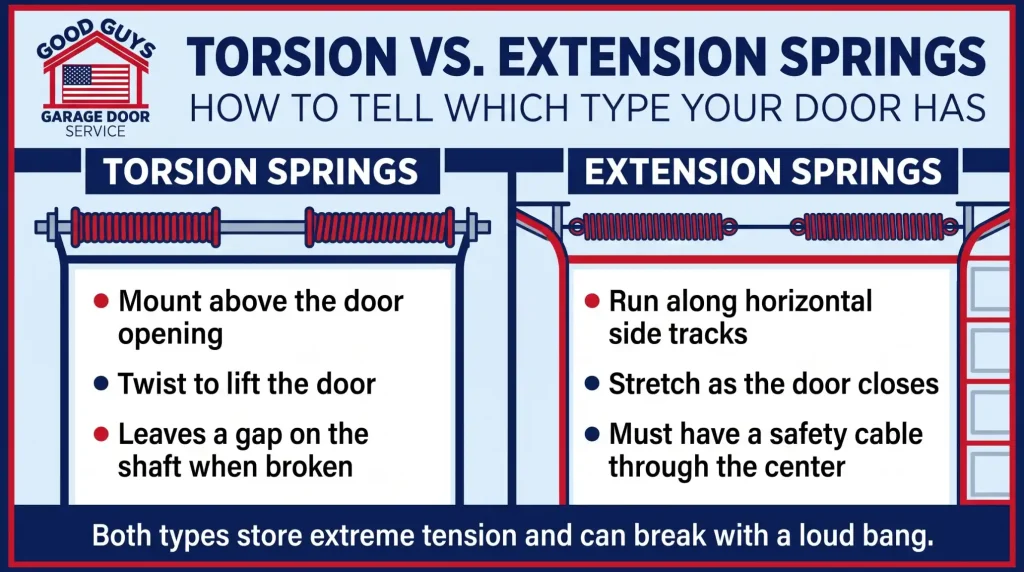
- Torsion springs mount on a metal shaft above the door opening and twist to lift the door. Most modern doors use them. When one breaks, it stays on the shaft and leaves a visible gap in the coil.
- Extension springs run along the horizontal tracks on each side of the door and stretch as the door closes. When one snaps, it can whip loose across the garage unless a safety cable runs through it.
The Door & Access Systems Manufacturers Association (DASMA) says every extension spring should have a safety cable running through its center, so a broken spring stays contained. If yours don’t, ask your technician to add them.
Why Garage Door Springs Break
What causes garage door springs to break
Springs don’t break at random. They wear out, and a few things speed that up:
- Normal wear. Standard springs are commonly rated for about 10,000 open-and-close cycles. For a household that uses the door about four times a day, that’s roughly seven years.
- Rust. Damp garages and humid New Jersey summers let rust form on the coils. Rust adds friction and weakens the steel.
- Cold weather. Cold doesn’t break a healthy spring on its own, but it adds stress to a worn one. That’s why a tired spring often gives out on a cold morning.
- No maintenance. Springs that are never lubricated or checked for balance wear out faster.
- The wrong spring for the door. A spring that’s undersized for the door’s weight, or a single spring doing the work of two, wears out early.
Springs aren’t the only part on a clock. If the door itself is approaching the average lifespan of a garage door, it’s worth weighing a full replacement against another round of repairs.
Why You Shouldn’t Replace a Garage Door Spring Yourself
Is it safe to replace a garage door spring yourself?
No. A torsion spring holds enough energy to lift a door weighing a couple hundred pounds. Winding or unwinding it means controlling that energy by hand with steel winding bars, and one slip can cause a serious injury.
Safety isn’t the only issue. A replacement spring has to match your door’s weight by wire size, length, and diameter. The wrong spring leaves the door out of balance, which strains the opener and wears out rollers and cables.
The parts connected to the springs are just as risky. The DIY editors at Family Handyman warn that the bottom brackets on torsion-spring doors stay under constant tension and should never be unbolted by a homeowner. Garage door manufacturer Clopay also puts spring noises, cable problems, and popping from the spring system in the call-a-professional category.
When you call for help, confirm the company is registered in New Jersey, and be wary of cheap garage door repair ad scams that advertise a rock-bottom spring price.
How to Make Your Next Springs Last Longer
How to extend the life of garage door springs
Once your new springs are in, a little maintenance goes a long way:
- Lubricate the springs twice a year with a light coat of garage door lubricant. Why Does My Garage Door Squeak? 7 Causes and How to Lubricate It the Right Way shows exactly where to apply it.
- Run a balance test once a month. Catching a spring that’s losing tension early can save the opener and cables.
- Ask about high-cycle springs. Springs rated for 20,000 cycles or more cost more up front but last proportionally longer, which is worth it if the garage door is your main entrance.
- Replace springs in pairs. Two new springs keep the door balanced and save you a second service call.
- Keep the garage dry. Less moisture means less rust on the coils.
If you’re choosing a lubricant for spring maintenance, the home improvement editors at Bob Vila tested seven garage door lubricants, which is a helpful place to start.
Loud Bang Checklist: Broken Spring or Something Else?
If the springs on an older door keep failing, the door itself may be the bigger problem. A new custom garage door is installed with springs matched to its weight from day one, and our homeowner guide to picking a new garage door walks through the options.
| What you notice | What it usually means | Safe to use the door? | What to do |
| Gunshot-like bang, gap in the coil | Broken torsion spring | No | Unplug the opener and call for spring repair |
| Door opens a few inches, opener strains | Broken spring | No | Stop pressing the button and unplug the opener |
| Door is heavy or won’t stay halfway | Broken or worn spring | No | Don’t force it; call a pro |
| Cable slack or off its drum, door crooked | Spring failure or cable damage | No | Keep clear; call for cable and spring repair |
| Extension spring hanging loose | Broken extension spring | No | Keep clear, check for a safety cable, call a pro |
| Rust, stretched coils, or popping | Spring near the end of its life | With caution | Schedule a replacement before it breaks |
| Bang, but springs and cables look normal | A roller out of the track, the door hitting the floor hard, or a spring about to fail | Check first | Look over the rollers and run a balance test; call if anything looks off |
Treat a Loud Bang as a Stop Sign
A loud bang from the garage is your door telling you to stop. In most cases, a spring has broken, and the safest move is to unplug the opener, leave the door where it is, and let a technician take it from there. If you hear popping or see rust before it gets that far, replacing the springs early saves you the scramble.
Good Guys Garage Door Service is a veteran-owned, residential-only garage door company based in Marlboro Township. We replace broken torsion and extension springs for homeowners across Monmouth County, including Freehold, Howell, and Middletown, plus nearby East Brunswick. You’ll get a clear price before any work begins, and same-day service is available when you need it. Veterans and seniors get 10% off.
Book a free estimate for your garage door springs or call (732) 299-3428, Monday through Saturday, 8 AM to 6 PM.